
Aesthetics of the Commons on the Migratory Phenomenon in the Work of Zanele Muholi, Marta Palau, and Lara Ruiz
DOI:
https://doi.org/10.54104/nodo.v20n40.2391Keywords:
Art and migration, Artistic methodology, intersectional feminism, decolonial studies, aesthetics of the commonsAbstract
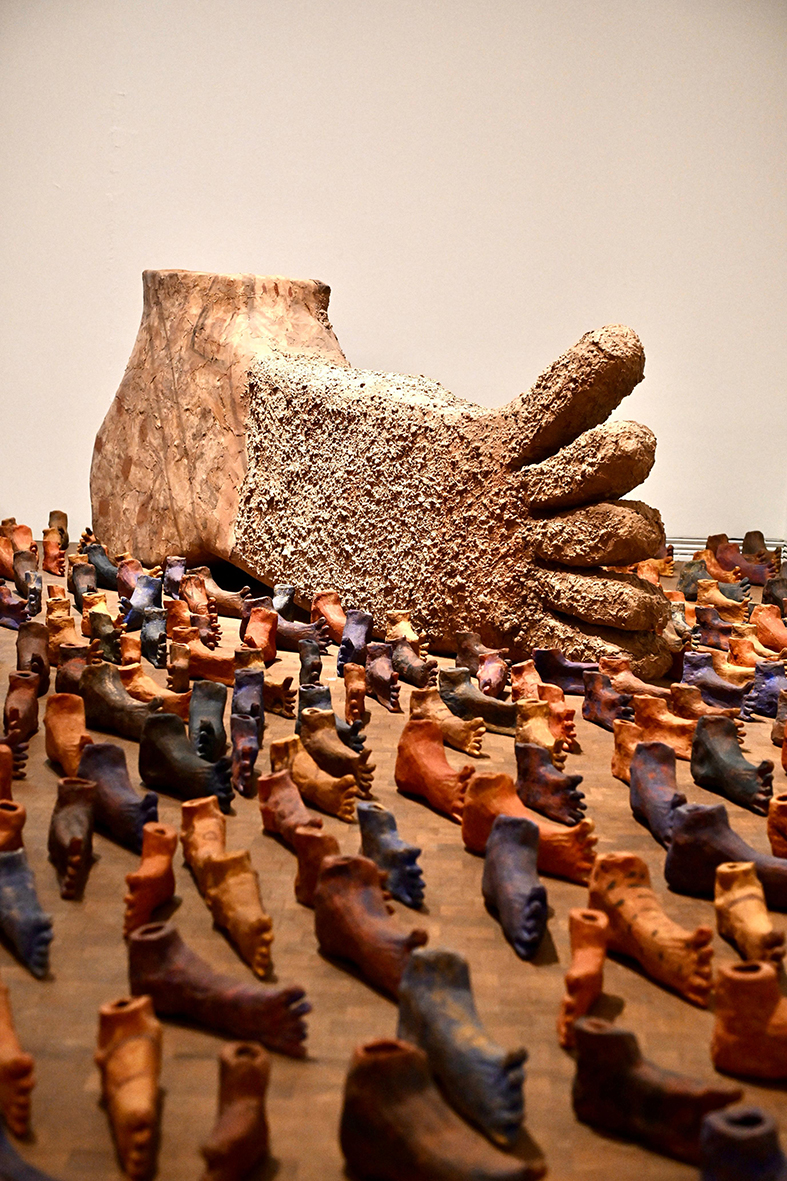
Where does the political agency of migrant art reside? In contrast to analyses centered on testimony or representation, this article argues that its critical force is fundamentally methodological. Drawing on a framework that integrates border thinking (Mignolo) as an epistemology of exteriority, black feminist critique (Lorde, hooks) as a theory of the gaze, and the agency of matter (Bennett) as a political ontology, we argue that the migrant condition activates poetics of remaking: formal and material strategies that translate the experience of displacement into critical procedures. A comparative analysis of Zanele Muholi, Marta Palau, and Lara Ruiz identifies three such strategies: 1) sovereign self-inscription, which establishes the body as a counter-archive; 2) transcultural material synthesis, which ritualizes mourning in matter; and 3) relational cartography, which produces the common through co- creation. Beyond their diversity, these practices converge in deactivating the spectacular aesthetics of trauma through specialized material tactics—over- inscription, materialization, and repair—that constitute an immanent critique of the necropolitical regime of the border. The article’s main theoretical contribution is the concept of an “aesthetics of the commons”, defined here in critical dialogue with its conservative genealogy (Hardin, 1968), yet reappropriated from a decolonial and feminist perspective as a material performance of the common. This concept synthesizes the political imaginary prefigured by the work of the selected artists: a horizon in which the common is performed as a sovereign body, material memory, and shared ground. Thus, the article repositions the debate, demonstrating that political transformation in migrant art is not proclaimed, but enacted through making.
Downloads
References
Acuña, G. (2017). Otras migraciones, las mismas fronteras: movilidades y percepciones de personas africanas en Costa Rica. En W. Soto Acosta (ed.), Repensar las fronteras, la integración regional y el territorio (pp. 231-242). CLACSO-IDESPO. https://eulacfoundation.org/system/files/digital_library/2023-07/doc_127.pdf
Amnistía Internacional (2022). ¿“Países seguros”? Por qué la designación de países de origen como “seguros” pone en peligro a las personas refugiadas. https://www.amnesty.org/es/latest/campaigns/2022/06/safe-countries-designation-endangers-refugees/
Anzaldúa, G. (1987). Borderlands/La Frontera: The New Mestiza. Aunt Lute Books.
Azoulay, A. A. (2019). Potential History: Unlearning Imperialism. Verso Books.
Bal, M. (2002). Travelling Concepts in the Humanities: A Rough Guide. University of Toronto Press.
Ballate Benavides, A. G., y de Armas Rodríguez, Y. (2023). Prácticas participativas y archivo sensible. En L. Ruiz (ed.), Edición continua (s.p.). Diputación de Cáceres. https://lararuiz.com/edicioncontinuabook/
Bennett, J. (2005). Empathic Vision: Affect, Trauma, and Contemporary Art. Stanford University Press. DOI: https://doi.org/10.1515/9781503625006
Bennett, J. (2010). Vibrant Matter: A Political Ecology of Things. Duke University Press. DOI: https://doi.org/10.1215/9780822391623
Bhabha, H. K. (1994). The Location of Culture. Routledge.
Bishop, C. (2012). Artificial Hells: Participatory art and the politics of spectatorship. Verso Books.
Bourriaud, N. (1998). Esthétique relationnelle. Les Presses du Réel.
Casino Luxembourg-Forum d’art contemporain (2024, septiembre 28-29). Common Scenery. https://casino-luxembourg.lu/en/agenda/common-scenery
Carlse, J. (2013). Crossing boundaries: religion, sexuality and identity in the lives of Zanele Muholi and Nkunzi Zandile Nkabinde (Thesis). University of Cape Town, Faculty of Humanities, Department of Religious Studies. http://hdl.handle.net/11427/14092
Cejas, M. (2020). Cartografiar desde el activismo visual y artístico en el sur global: Zanele Muholi y Mujeres públicas. Feminismo, cultura y política. El contexto como acertijo, 191-228. http://biblioteca.clacso.org/Mexico/dcsh-uam-x/20201116030630/Feminismo-Cultura.pdf
Crenshaw, K. (1989). Demarginalizing the Intersection of Race and Sex: A Black Feminist Critique of Antidiscrimination Doctrine, Feminist Theory and Antiracist Politics. University of Chicago Legal Forum, 1989 (1), 139-167. https://chicagounbound.uchicago.edu/uclf/vol1989/ iss1/8
De Genova, N. (2017). The Borders of “Europe”: Autonomy of Migration, Tactics of Bordering. Duke University Press. DOI: https://doi.org/10.2307/j.ctv11smr05
De la Cadena, M. (2015). Earth Beings. Duke University Press. DOI: https://doi.org/10.1515/9781478093626
Demos, T. J. (2013). The Migrant Image: The Art and Politics of Documentary during Global Crisis. Duke University Press. DOI: https://doi.org/10.1215/9780822395751
Directiva 2013/32/EU del Parlamento Europeo y del Consejo, de 26 de junio de 2013, sobre procedimientos comunes para la concesión o la retirada de la protección internacional. (2013). Diario Oficial de la Unión Europea L 180/60. https://eur-lex.europa.eu/legal-content/ES/TXT/ ?uri=celex%3A32013L0032
Durán, J. (2018). El arte del exilio. Cátedra.
ECRE – European Council on Refugees and Exiles (2023). The EU Pact on Migration and Asylum: A Comprehensive Analysis. ECRE Policy Paper.
Federici, S. (2019). Reencantar el mundo. Tinta Limón.
Fikrig, M. M. (2018). Haunted by solitude: Isolation and communal representation in Zanele Muholi’s archive (Honors thesis). Oberlin College. https://digitalcommons.oberlin.edu/honors/151/
García-Ranedo, M. (2016). Fotografía sudafricana y género. Asparkía: investigació feminista, núm. 28, 51-73. https://raco.cat/index.php/Asparkia/article/view/318692.
Haraway, D. (1988). Situated Knowledges: The Science Question in Feminism and the Privilege of Partial Perspective. Feminist Studies, 14 (3), 575-599. DOI: https://doi.org/10.2307/3178066
Hardin, G. (1968). The Tragedy of the Commons. Science, 162 (3859), 1243-1248. DOI: https://doi.org/10.1126/science.162.3859.1243
hooks, b. (1990). Yearning: Race, Gender, and Cultural Politics. South End Press.
hooks, b. (1992). Black Looks: Race and Representation. South End Press. https://aboutabicycle.wordpress.com/wp-content/uploads/2012/05/bell-hooks-black-looks- race-and-representation.pdf
hooks, b. (1995). Art on My Mind: Visual Politics. The New Press. https://monoskop.org/images/7/7b/Hooks_Bell_Art_on_My_Mind_Visual_Politics_1995.pdf
Kester, G. H. (2004). Conversation Pieces: Community and Communication in Modern Art. University of California Press. https://www.sholetteseminars.com/wp-content/up loads/2018/01/Kester_chapter_ONE_Conversation.pdf
Lara Ruiz, R. y Ranilla Rodríguez, M. (2024). Terreno modular: prácticas artísticas participativas de resistencia y comunidades emocionales en migración, desde La Habana a Cáceres. Arte y Políticas de Identidad, 31, 108-131. https://doi.org/10.6018/reapi.606201 DOI: https://doi.org/10.6018/reapi.606201
Lorde, A. (1984). Sister Outsider: Essays and Speeches. The Crossing Press.
Lugones, M. (2007). Heterosexualism and the Colonial / Modern Gender System. Hypatia, 22 (1), 186-219. https://www.jstor.org/stable/4640051 DOI: https://doi.org/10.1111/j.1527-2001.2007.tb01156.x
Massey, D. (2005). For Space. SAGE Publications.
Massot, J. (2025). Marta Palau, la artista olvidada del exilio republicano catalán, vuelve a casa. La Vanguardia. https://www.lavanguardia.com/cultura/20250220/ 1002055752/marta-palau-artista-olvidada-exilio-repu blicano-catalan-vuelve-casa.html
Mbembe, A. (2003). Necropolitics. Public Culture 15 (1): 11- 40 (trans. Libby Meintjes) DOI: https://doi.org/10.1215/08992363-15-1-11
Mezzadra, S., y Neilson, B. (2013). Border as Method, or, the Multiplication of Labor. Duke University Press. DOI: https://doi.org/10.2307/j.ctv1131cvw
Mignolo, W. D. (2000). Local Histories/Global Designs: Coloniality, Subaltern Knowledges, and Border Thinking. Princeton University Press.
Mignolo, W. D. (2011). The Darker Side of Western Modernity: Global Futures, Decolonial Options. Duke University Press. DOI: https://doi.org/10.2307/j.ctv125jqbw
Osakar Olaiz, P., Lozano Salmerón, A., y Barrionuevo, F. (eds.). (2023). Senda. Sendas del viajero / PATH. Traveller’s Paths (Catálogo de exposición). MECA Mediterráneo Centro Artístico. https://digibug.ugr.es/bitstream/handle/10481/100908/Cata%CC%81logo-SENDA-PhotoEspan%CC%83a-2021-3.pdf?isAllowed=y& sequence=1
Poulain, A. (2020). Self-portrait as epistemic disobedience: Zanele Muholi’s Somnyama Ngonyama. InMedia, 8(2). https://doi.org/10.4000/inmedia.2409 DOI: https://doi.org/10.4000/inmedia.2409
Prieto, I. (2025). Magia e historia: resistencia de un arte en espiral. En Marta Palau. Mis caminos son terrestres. Museu Tàpies.
Quezada Ortega, M. de J. (2007). Migración, arraigo y apropiación del espacio en la recomposición de identidades socioterritoriales. Cultura y Representaciones Sociales, 2(3), 35-67. https://www.scielo.org.mx/scielo.php?script=sci_arttext&pid=S200781102007000200003&lng=es
RTL Today (2025, 14 de enero). Population growth: Luxembourg City reaches 136,208 residents in 2024. Retrieved January 22, 2026, from https://today.rtl.lu/news/luxembourg/luxembourg-city-reaches-136-208-residents-in-2024-2267041
Ruiz Benedicto, A. (2025). Estados amurallados en el siglo XXI. Orden Internacional, Revista de Estudios Internacionales, 1, e74. https://revistas.urjc.es/index.php/roi/article/view/74/62
Rojo Betancur, F. A. (2009). Resignificaciones del pensamiento mágico ancestral y del arte rupestre mesoamericano. La obra de arte como fetiche contemporáneo. Rupestreweb. http://www.rupestreweb.info/artefetiche.html
Salley, R. J. (2012). Zanele Muholi’s Elements of Survival. African Arts, 45(4), 58-69. https://www.jstor.org/stable/ 41721405 DOI: https://doi.org/10.1162/AFAR_a_00028
STATEC (2024). Population by nationality. Luxembourg: Statistical Office of Luxembourg.
The Guardian. (2026, 14 de enero). Trump administration halts immigrant visa processing from 75 countries. The Guardian. https://www.theguardian.com/us-news/2026/jan/14/immigrant-visas-suspended-trump
Van Laerhoven, F., y Ostrom, E. (2007). Traditions and trends in the study of the commons. International Journal of the Commons, 1(1), 5. DOI: https://doi.org/10.18352/ijc.76
Yin, R. K. (2018). Case Study Research and Applications: Design and Methods (6th ed.). SAGE Publications
Downloads
Published
-
Abstract125
-
PDF (Español)56
How to Cite
Issue
Section
License
Copyright (c) 2026 Raquel Lara Ruiz, Felismino Borges Da Silva

This work is licensed under a Creative Commons Attribution-NonCommercial-ShareAlike 4.0 International License.

 Portal de Ciencia Abierta